
Spring Wild Edibles Webinar Today, Wednesday April 19th
| Kate Armstrong will be with us at 11:00 AM MDT and tell us about urban foraging. You really can eat dinner from that weed patch down the street. Find out how! |
| https://attendee.gotowebinar. |
Happy New Year! Want A Resolution? Grow Something!
This year, figure out how to supply yourself with all or most of one food or plant product – for a season or for the year. What can you grow within the confines of your current home/living space? What is your favorite vegetable, herbs, or fruit? What do you love to eat? What do you want to have on hand? What can you find or forage from the neighborhood close by?
I love herbs for cooking, both fresh and dried. Parsley, chives, thyme, rosemary, mint and so many more can easily be grown on a sunny window sill, counter, table top or in a floor pot. For some places vertical growing is an easy answer on a sunny wall – inside or out. When you grow herbs, you can easily dry them, save them, and give the excess as gifts to others. Start small. Look at your herbs and see which one is used the most. Plan on having a supply of parsley (for instance) that you grow for yourself – in time to replace the dried herb in the cabinet when it runs out.
If you have a wall outside or planters, think about what you can grow that you enjoy eating. Peas can climb a wall, as can green beans, squash, cucumbers, and melons. You will need some support – I’ve used a cotton 4″ square netting to grow even heavy winter squash successfully. You can even let them mature in the gutter or on the roof if you can harvest them there safely.
Green beans are wonderful fresh, frozen, fermented and pickled. They are even good dried! Figure out how many servings of green beans you want for the year and then find out how many plantings you need in the space you have. You can make a Teepee on the deck with tall bamboo poles stuck in pots with 3 beans in each pot.
Most cities have fruit trees, grapevines, and berries that have been planted by others and are still bearing. Find ones near you (an apple tree, berry bush, or grape vines for instance) and keep an eye on them. When they are full of fruit, ask if you can harvest it and offer some to the home owner if they want some. I frequently find the home owner is glad to be ‘rid’ of them because they are making a mess!
So for now start small with a favorite herb, some veggies in a pot, or a dwarf fruit tree and learn how to take care of them. Enjoy the fruits of your effort, and then see if you want to do more. Please ask a salesperson if what you are buying is free of systemic pesticides. No one needs to eat anymore poisons!
I’d love to hear from you and learn what you have decided to grow and where you are growing it. Maybe you can team up with neighbors and each person grow a different food then share. Taking charge of any part of your food supply is an important step so get growing! Happy New Year!
Protecting the Water for us all!
Here are a few comments from my time at Standing Rock Camp – November 11-15, 2016
This is a camp of ceremony and prayer, and the Sacred Fire is kept going around the clock. There is prayer all day long, and usually until late evening as well. The active call to prayer and action is before sunrise and it honors the sun and all of creation. It is followed by a Sacred Water ceremony at the Cannon Ball Rivers edge where elder women go first. Water bearers are the women in the tribes. As an elder woman, I was treated with more respect and dignity than I have ever had anywhere.
This is a place where for the first time in history over 400 Native Tribes have gathered together for the same purpose, to stop the Black Snake – DAPL, from contaminating the waters of the Missouri, and the drinking water of +/- 18 million people downstream. These warriors (both male and female of all races) go to the front line to keep the DAPL workers from working each day. The Elders also go to do ceremony for the water, and the warriors try to keep the police from them. The actions of the police toward these peaceful elders and the unarmed warriors is simply brutal. Tear gas, pepper spray, mace, batons, and dogs have been used to try to drive them away. Up to 130 people per day have been jailed, and some forced into dog kennels instead of jail cells.
The camp is preparing for a hard winter. It is well organized, full of teepees, yurts, tents – from huge army tents to single person tents – and has a large volunteer staff to sort and distribute clothing, blankets, sleeping bags, food, and wood. There are porta-pottys, recycling, garbage, composting, and kitchens.
There is also the council of Seven Tribes, and many people from around the world here to stop the further poisoning of the water and the Earth. I met or saw Catholic Monks, Buddhist Monks, Ukrainians, Israelis, Palestinians, Mexicans, Europeans from north to south, Scandinavians, Africans, and more too numerous to count.
All of us need to keep this protection of the water high on our list of things to support and help everyday. This is for us all; this is as important as anything I can think of. A spill into this water could make the whole Heart Land of America a poisoned land.
I came away with a sense that there may be divisions among the camps on the Cannon Ball River, there may be some young hot heads causing trouble, and there is a divided opinion among the Dakotas about what to do; however the tactics of the DAPL folks is horrible and barbaric, and there are other ways to go than the contamination of the Missouri river!
We all need everyone’s help to take back our Earth from the companies that are poisoning it, or we will not have a place to live safely. This is one of the lines between living healthy or dying on our Earth. This land and ALL land is Sacred. We need to treat it as Sacred right now. We can’t make any more water!
Mni Wiconi – Water is Life –
Wild Edible & Medicinal Plant Walk June 11, 2016
Come to Standley Lake Nature Center from 9 – 11 am this Saturday for a chance to learn about the edible and medicinal plants growing wild in our area. I will be exploring the immediate area around the Nature Center for late Spring plants and what they are good for! This is a good introduction to local wild edibles and some of their medicinal properties as well. See you then!
Pansies!
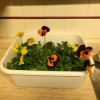
Funny how that word has such a different expression when applies to people rather than plants! These plants are hardy, come in the most beautiful colors, smell sweet, and are planted when the rest of the annuals are dying in the Fall, or are hardy early in the Spring. They even seed in and come up again in the Great White North rearranging themselves through hybrid seeds into new combinations of colors and faces!! With all this going for pansies, it seems strange that it is not a compliment to be called a ‘pansy’!
I brought home six very flat, dehydrated pots of pansies from a job we just finished planting this week, either to save them or compost them. I would have bet on the side of composting them. Lo and behold, in an hour or so they came back totally – a seeming impossible task!
So what does that say about a Pansy? It’s also know as Heart’s-Ease and Love-In-Idleness, however the 1905 Webster’s Dictionary has no mention of a person being a pansy! Hum-m-m-m…
Spring Walk & Talk April 12th
It’s Spring time, time for the Urban Forager to kick into high gear and start those fascinating discussions about the wild edibles in your yard and in your neighborhoods. The wild Spring greens are very valuable for tuning up your body gently and easily, as well as being loaded with vitamin and mineral goodness. Every season brings its own delightful wild plants, free for the picking, and each walk is focused on different ones you can use for your benefit. Come join me by signing up for the First Wild Edible Spring Walk of 2014.
If you are busy this Saturday and can’t come to Sustainability Park, think about getting some of your neighbors together for a talk & walk in your own neighborhood! Contact me and we can do it on your schedule. Everyone benefits from knowing what’s edible and free! Sign up by going to the live link under First Wild Edible Walk of the Spring!
Happy Foraging!
What’s up with Those Crazy Squirrels??!!??
This year the squirrels have been exhibiting the most radical behavior most of us has ever seen. What? Are they nuts? I mean seriously!! Every year I move my hibiscus outside for the summer. It thrives in the warm weather, blooms profusely, and grows new branches. After it was outside for a month, I noticed the blooms had been eaten off, and the new branches were nipped through – as well as some of the old branches. I moved it back inside. Squirrels!
To screen the southern end of the front porch from sun and the neighbors, a friend helped me hang netting for the hops to climb. They were lush and full of those little shrimp-like pods with the yellow oil under the green ‘scales’. My head was full of notions of homemade ale when I came home one night to see that the netting and most of the hop vines were nipped through leaving raggedy bits of string and a scattering of hops all across the porch. The squirrels had struck again! The weedy sumac growing next to the porch had branches missing, tattered leaves, and gnawed stems! Really?
Checking with my daughters I found that at one house the squirrels were seen in a committed community action, four of them working a ripe tomato over to the net and finally eating it through the plastic bird netting when they couldn’t get it out! Her squash vines were nubs with a leaf or two, and so were the cucumber vines. My other daughter’s veggies fared better only because there is a huge oak tree in the back yard. Of course it is hard to sit out there because of a constant rain of shell bits and nut casings. All over town I hear of peculiar squirrel activities: all the flowers gone from a row of sunflowers; biting through screens and coming into homes to eat the pet food; stripping grapes off the vine and many such vandalistic activities!
Well, actually I do know why this is happening and what the solution used to be! Thinking back to the farm days, it was to be expected. You see, last year we had the most prolific crop of stone fruits to be seen in the Denver area for a long time. Everything that produces fruit was so full to overflowing, branches were breaking with the weight of peaches, apricots, apples, and plums. June berries were ripe by the thousands, grapes hung in great clusters, and cherries were picked by walking by on the sidewalks of the city! Foraging fruits was a full time job, and even then, many fruits rotted on the ground, on trees, on vines, and in alleys. The squirrels were in ‘hog heaven’ so to speak. Their solution? Let’s have more babies!
Last year, a thought rose unbidden in me: harvest and save all the fruit you can this year because with a year this good, next year will be very poor. Now my modern, rational mind said “Oh, that’s just an old wives tale!” Not so! For this spring had two late killing frosts that pretty much took out all the blossoms for stone fruits. But what about the squirrels? They still had those big litters of babies and no super abundance to feed them! What to do now?
If this were back on the farm, this year would be a time to harvest squirrels – or ‘limb chickens’ as they were also known. There would be squirrel stew, squirrel lining to mittens, hats and warm furry neck scarves. Squirrels would be dried, frozen and smoked. You harvested what was abundant in it’s own time, put it by, and knew it might be awhile before it was abundant again. Not harvesting the squirrels pretty much guarantees the up-surge of city foxes and coyotes next year since they consider squirrels their food!
The circle of life. Remember when this had distinct meaning and rhythm to all of us? It still does, you know. We can become distanced from the cycle of life, but it comes to us anyway. Basically this is another example of Nature being outside of our control. I suggest we go with the flow, and stop bucking what is true. Also next year I would definitely keep all little pets inside since that abundance of squirrels will not survive the winter, and the abundance of city foxes will be hungry come spring!
Last Wild Edible Walk of the Season!!!
As the summer winds down, albeit slowly, the weeds are also on their way to Autumn shapes and colors. This is a fine time to see what to do to harvest wild amaranth seeds, and which plants to flag for picking even under snow! All the regular characters are still present and available and so one more weed walk is called for!! Come learn about eating, saving, harvesting, and using these wonderful plants for home remedies. Sign up at: http://tentiko.com/products/finding-food-in-the-city We are meeting on Saturday, September 14th from 9 – 11 am, so make sure you sign up and show up! It’s going to be another Wild Walk!
The Wild Foraging Season Has Begun!
Get ready to start picking and eating from your yard and garden! The young Spring plants are starting to show themselves and the next Wild Edible Walk of the season is May 11th, this Saturday! Join me at 9 am on the corner of 44th Avenue & Vallejo Street in the Sunnyside neighborhood to see what we can find out there to eat! To sign up and read more about this event go to: http://www.feeddenver.com/classes–events.html
Foraging and Our Pioneers
Have you ever been to Four Mile Park? Maybe it’s time to give this historical Park in the city a closer look. I will be doing just that on Saturday May 4th. I have been invited to give a foraging talk at their Victorian Tea on that day, and I am really looking forward to it! I will learn as much as the people who attend this event, I’m sure.

Victorian Tea
Saturday, May 04 | 1:00 pm–3:00pm
As a working farm and ranch, Four Mile Historic Park was once supplied with edibles primarily from the land around the buildings, either in organized gardens or by gathering wild edibles that grew in the area. Join us at our Victorian Tea where Kate Armstrong, Urban Forager, will share the usefulness of the plants we normally ignore now; how some of them were brought to America from Europe because of their use as food and medicine; and how most rural and urban people knew how to supply themselves with simple meals, home remedies, and household products from these plants.
About the Presenter: Kate Armstrong has an educational and entertaining style that will add to your knowledge of these earlier times, give you food for thought, and may even interest you in harvesting some of the plants you now consider weeds! She brings a lifetime of experience to the subject as well as a wealth of helpful information. There will also be examples of the products she makes and uses from her backyard, the alley ways, and the neighborhoods in Denver. You will be able to identify (and taste) plants that are already up and growing since she will be bringing examples of these with her. http://urbanforager.co/about-kate-armstrong/
$30 Non-Members | $25 FMHP Members
Advance payment is required by Thursday, May 2 at 4:00pm. Limited seating available.
For more information, please call 720-865-0815 or email info@fourmilepark.org

